
🔐 TPM Microguide: Skills That Will Matter for TPM To Be AI Ready
A short guide designed to help TPMs figure out what skills will be important and what skills you will need to adapt to make yourself ready for an AI world.
Hi, I am Aadil and I write this newsletter on the art of doing technical program management.
You are reading a “TPM Microguide” designed for my paid subscribers. These are concise, actionable guidebooks designed to help TPMs level up in specific areas of their craft — whether it’s mastering technical concepts, building program structures, or learning how Apple builds software. If you want full access, please consider becoming a paid subscriber.
My aim is to publish a new guide every month.
If you have Feedback and/or Suggestions to improve this guide, please leave a comment. Only paid subscribers who have access to the guide can leave comments.
OR reach out to me for any questions - aadilmaan at gmail.com.
Purpose of This Microguide
This microguide is designed to help TPMs figure out what skills will be important and what skills you will need to adapt to make yourself ready for an AI world.
Over the past year, through my own projects, conversations with other TPMs, giving talks at tech companies, and watching the shifts happening in our industry, I’ve seen the outline of what TPMs will need to succeed in the AI era.
How to Use This Microguide
Every section is written in a modular way so feel free to copy, remix, or adapt anything here including the proposed project plan template.
How I Write These Microguide
All microguides are built on a combination of in-depth research and my 15+ years of experience leading complex programs in the tech industry. I take the time to deep dive into the core pillars of each topic, aligning research with real-world insights from the industry where ever possible.
Rather than focusing solely on academic theory, I reframe the research to highlight the most practical and relevant aspects for Technical Program Managers (TPMs). The result is content rooted in reality, offering empirical insights that help TPMs navigate challenges with a practical, execution-focused approach.
TPM Skill Guide For Those Looking to Survive The AI Transition
Every time the environment around us changes, a new kind of gap appears. On one side is where you are today; the skills you already have, the patterns you already know. On the other side is what tomorrow will demand; new capabilities, new ways of working. The people who thrive in times of change aren’t necessarily the smartest. They’re the ones who can spot these gaps early and move quickly to close them.
The ones who get left behind usually fall into two groups:
Those who never recognized the gap at all.
Those who realized too late that the world had already moved on.
Over the past year, through my own projects, conversations with other TPMs, giving talks at tech companies, and watching the shifts happening in our industry, I’ve seen the outline of what TPMs will need to succeed in the AI era.
Some skills are foundational, the core essential that will never go away or not matter. Others are new, and investing in them now will separate you from those who are just “using AI” versus those who are truly leading with it.
This guide is my attempt to map out those skills: the foundations you must protect, the new muscles to start building, and the technical knowledge you’ll need if you want to steer AI projects rather than just react to them.
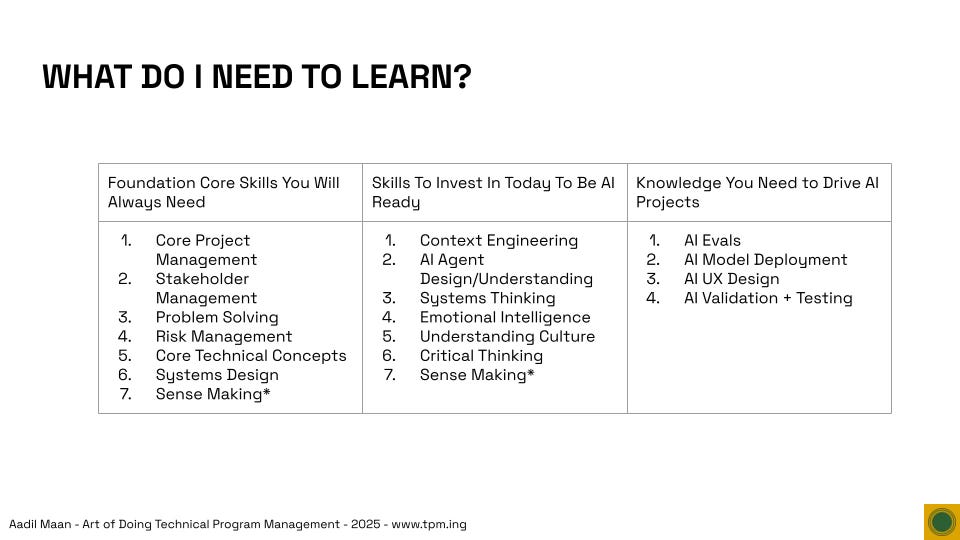
Foundation Skills You Will Still Need
Even in a world where AI is everywhere, the core of Technical Program Management remains unchanged. If you don’t have these, no amount of AI tooling will save you. It will actually be the primary difference between people seeing you leverage AI effectively versus just churning out AI SLOP.
Core Project Management
This is the bedrock of TPM work and will never go away. Why? Because AI can generate documents, plans, and schedules but it cannot tell you whether they make sense for your team, your product, and your context. That judgment is yours alone.
Requirements gathering, breaking down work, mapping schedules, reporting progress, and driving agile ceremonies like sprint planning and milestone tracking, these are the levers that move teams forward. The TPM who knows how to apply these in the right way at the right time ensures that AI outputs turn into progress rather than chaos.
Stakeholder Management
AI might do a decent job of keeping your VP aligned with your designer, or balance priorities between infra and product. But true impact of where things go off-track and keep people from losing their minds, that’s your job.
TPMs who excel here understand how to bring together cross-functional groups with competing goals and keep them aligned around a shared plan. Your ability to influence across layers of management will remain one of the most human and irreplaceable skills you own.
Problem Solving
Between Jira tickets and status reports, problem solving is the skill that truly defines TPM impact. It might mean mobilizing engineers to debug a thorny issue, guiding leadership through tough roadmap tradeoffs, or building a path back to green for an off-track project. The ability to calmly, systematically, and creatively work through obstacles is the TPM’s superpower and it only grows in value when AI adds more moving pieces to manage.
Risk Management
Strong TPMs don’t just track risks, they anticipate, mitigate, and adapt. Risk management is what makes the difference between projects that feel “under control” and those that constantly slip. In the AI era, risks multiply: hallucinations, model drift, AI slop, etc. How to leverage AI with risk will depend on your ability to first off all understand the ABC of risk management and then leveraging AI to help you proactively address those risks.
Core Technical Concepts
You don’t need to write production code, or ship bug fixes (you could if you want 😉) but you must understand the mechanics of software. APIs, deployment pipelines, differences between staging, QA, and production, how unit/regression/exploratory testing works, these are non-negotiables. Without this grounding, you can’t build credibility with engineers or shape realistic schedules. The “T” in TPM still stands for “Technical.”
Systems Design
Great TPMs know how systems fit together. That means understanding latency tradeoffs in web apps, how front-end patterns accelerate development, and the scheduling implications of monolithic vs. microservice architectures. This is the skill that elevates you from simply tracking work to helping teams design solutions that are technically feasible and strategically aligned.
Sense Making*
At Google, they called it “Googliness.” I call it the core TPM art: sense making. It’s the ability to pull together fragments of information (metrics, bug counts, shifting deadlines, hallway/zoom/slack conversations) and see the real story emerging. It’s knowing when a delay in design is still safe and when it’s catastrophic, when a high bug count is noise and when it’s a signal to escalate. Sense making is what keeps programs on track in the face of complexity.
Skills To Invest In Today
These are the muscles that will matter most in the AI-native era.
Context Engineering
Forget the hype about “prompt engineering.” (LONG LIVE THE KING) The real future is context engineering; it is the craft of structuring data, prompts, and workflows so that AI outputs are accurate, reliable, and useful. This isn’t just writing clever instructions. It’s about giving the model the right environment to operate in, minimizing hallucinations, and shaping consistent outcomes.
AI Agent Design/Understanding